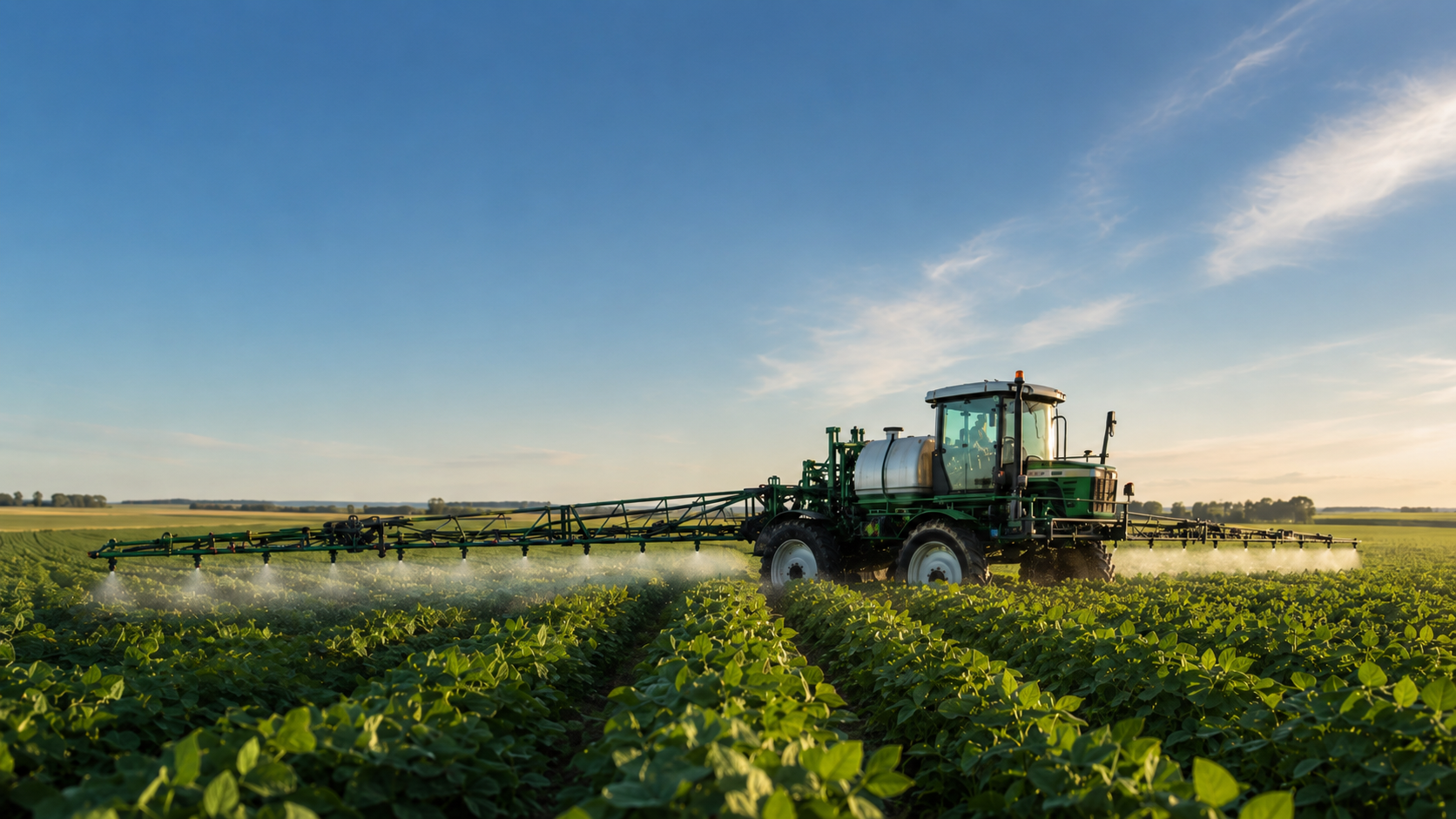
Adjuvants for agricultural spraying: less loss, better results per hectare
Adjuvants for agricultural spraying are among the highest-impact inputs in crop protection applications — and among the least considered when preparing the spray tank. Argentina’s agricultural season covers millions of hectares every year, and a significant portion of the pesticide or fertilizer applied never fulfills its purpose: lost to drift, runoff or degradation on the leaf surface before absorption occurs.
Adding the right adjuvant to the spray tank is not an additional cost: it is a decision that improves the return on every liter of product applied.
What is an adjuvant and how does it work in the spray tank?
An adjuvant is a product added to the spray solution to modify its physical properties and optimize the performance of the active ingredient. It does not replace the pesticide or fertilizer — it enhances their action on the crop.
Adjuvants act on four key variables:
Surface tension
By reducing the surface tension of the spray solution, the adjuvant improves adhesion and coverage on the leaf surface. The droplet does not bounce or run off: it spreads and is retained on the leaf, maximizing the contact area with the active ingredient.
Droplet size
Drift-reducing adjuvants allow optimization of the droplet spectrum for each application condition. A larger droplet is less susceptible to wind displacement, reducing drift losses without affecting coverage uniformity.
Cuticular penetration
Penetrant adjuvants facilitate the passage of the active ingredient through the leaf cuticle, improving systemic absorption of the product. This is especially relevant in contact herbicide applications and foliar fertilization programs.
Tank mix stability
In multi-product tank mixes, stabilizing adjuvants prevent phase separation and maintain homogeneity throughout the application, ensuring uniform distribution of the active ingredient from the first pass to the last.
The drift problem: how much product is actually being lost?
Drift is the loss of product that occurs when fine droplets are carried away by wind before reaching the crop. In moderate wind conditions without a drift-reducing adjuvant, estimates suggest that between 15 and 30% of the applied product may never reach its target.
This has two direct consequences: economic loss for the grower and risk of contamination of neighboring crops or water bodies. The use of drift reducers is especially recommended in:
- Aerial application operations
- Wind conditions above 15 km/h
- Crops with smooth or waxy foliage where bounce is frequent
- Applications near field boundaries or buffer zones
Foliar liquid fertilizers: precision nutrition at critical growth stages
Foliar fertilization allows the application of nitrogen, phosphorus, potassium, sulfur and micronutrients directly to the leaf surface at the moments of highest crop demand. Unlike soil-applied fertilization, the response is rapid and does not depend on soil moisture conditions.
Combined with a penetrant adjuvant, foliar fertilizers maximize nutrient absorption and allow dose reduction while maintaining the agronomic effect. This combination is especially efficient in:
- Correction of micronutrient deficiencies at advanced vegetative stages
- Foliar nitrogen applications in winter crops under stress conditions
- Integrated nutrition programs designed to reduce soil fertilizer load
Spray water treatment: the hard water problem
The water used to prepare the spray solution has a direct influence on product efficacy. Hard water, with high concentrations of calcium and magnesium ions, significantly reduces herbicide performance — particularly glyphosate. Divalent ions form complexes with the active ingredient that inactivate it before it reaches the plant.
Water conditioners work by sequestering these ions and adjusting spray solution pH to the optimal range for each active ingredient. Their use is especially important in:
- The Pampas region, where groundwater frequently exceeds 300 ppm hardness
- The NOA region, where water hardness can be even higher
- Any situation where reduced efficacy of glyphosate or other systemic herbicides is observed
A well-formulated water conditioner can recover up to 15% of efficacy lost to water hardness, without the need to increase herbicide dosage.
“The same ion sequestration chemistry used in spray water treatment is also applied in industrial mineral processing. See how it works in our article on lithium slurry dispersants and scale inhibitors.”
Formulations developed for Argentine farming conditions
Most adjuvants available in the local market are imported products, formulated for European or North American conditions — different process water, different climates, different crops. Argentine farming conditions span an extraordinary range: from the Puna plateau to Patagonia, from the NOA to the Pampas. Each of these regions has specific characteristics that directly affect adjuvant performance.
Kimiker develops and manufactures adjuvants and liquid fertilizers at its own production facility in Argentina, with the capability to adjust formulations to the requirements of each crop, application condition and water quality. The technical team supports product selection for each situation and provides assistance during implementation.
Talk to Kimiker’s technical team
If you want to improve the efficiency of your applications — or your clients’ — the first step is evaluating current conditions: water quality, crop type, application equipment and products in use. With that information, Kimiker’s team can recommend the most suitable adjuvant and foliar fertilizer combination.
📧 contacto@kimiker.com.ar 📞 +54 9 11 3288 3191 🌐 kimiker.com.ar
Kimiker SRL — Industrial Chemical Products Av. Rodríguez Peña 3355, San Martín, Buenos Aires, Argentina.